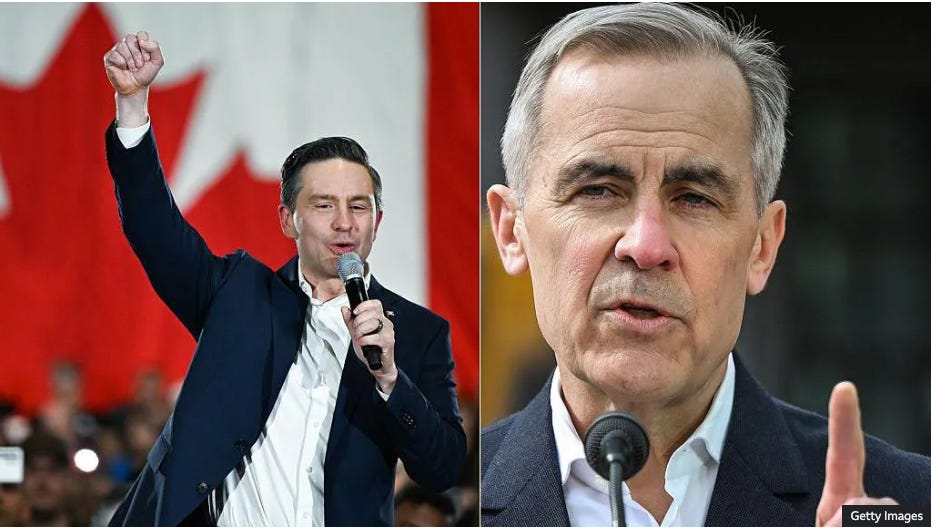
My latest scribble predicts that a 2026 federal election is inevitable.
Even with a strong minority, Mark Carney has reasons to want an election in 2026, and he will provide the opposition with enough reasons to vote his government down.
Many journalists, talking heads, and the commentariat are working hard to read the tea leaves concerning the timing of the next federal election. After April’s result, many believed that the strong minority government Prime Minister Mark Carney won would encourage him to oversee a lengthy parliament of about two to three years before going to the voters. The punditry was convinced that the opposition parties would have no interest in facing the popular Carney, and the Liberals would be content to introduce their leader as a no-nonsense fixer who was the right man for the times. In a quote attributed to Vladimir Lenin, the leader of the Russian Revolution, the old Bolshevik said, “There are decades where nothing happens; and there are weeks where decades happen.” Since April, much has happened to change the political landscape, and Canadians seem unalterably headed back to the polls in 2026, likely in the spring or summer. Determining the timing is better left to the stargazers, but accounting for why the election will happen sooner rather than later comes down to four solid reasons.
Thanks for reading David’s Substack! Subscribe for free to receive new posts and support my work.
AFFORDABILITY
Canadians remained frustrated by the cost of most items, though the cost of fueling up the car has remained stable. Otherwise, grocery shopping has become a series of winces and ouches as prices seem to rise week to week and cutting back or looking for deals becomes obsessive for folks trying to make a loony stretch. The prime minister made promises regarding the cost of everyday food products. He indicated that trade deals with other countries would help to stabilize prices and that he would manage U.S. President Donald Trump and secure an agreement to peel back the tariffs. He also told young people that housing would be built and would be affordable. Our new prime minister, fresh from overseeing the Bank of England, was entrusted with solving the problems his predecessor had created. His colleagues on the world stage assured Canadians that they could deal with Canada, knowing that a statesman like Carney held the office. So far, this issue has eluded the soft touch of Carney’s financial magic. If prices remain high and inflation ticks up, this issue alone could sink Carney and the Liberals, despite the prime minister’s positive ratings.
RESOURCE DEVELOPMENT
When Carney rose to the leadership of the Liberal Party last year, he sounded definite about his plans to develop Canada’s resources. He wanted to respond to Trump’s criticisms of Canada’s reluctance to build pipelines under former prime minister Justin Trudeau. After taking office and then winning the election, he began to speak with less certainty, outsourcing “no to pipelines” or other resource development that hurt his chances within the environmental wing of his party. At this point, the Conservatives smell dithering, delay, and vacillation on Carney’s part. He was recently in Alberta to sign a Memorandum of Understanding to build a pipeline. The press will cover it like a done deal. The government will accept the accolades, but Conservative Leader Pierre Poilievre properly called him out in the House of Commons last week (Nov. 26), calling the announcement old news because the prime minister refuses to use his constitutional powers to enforce the construction of the pipeline. As Poilievre claimed in his House of Commons volley with both Steven MacKinnon (Minister of Transport and Leader of the Government in the House of Commons) and Tim Hodgson (Minister of Energy and Natural Resources), Premier David Eby of British Columbia has no authority to block pipelines. Only Carney has the authority to do so as per the British North American Act, Article 92(10)(a)(b), which “grants federal jurisdiction over modes of interprovincial and international transportation and communication, leaving intraprovincial transportation and communication to the provinces. The legal interpretation ejusdem generis limits the scope of the exceptions to subsection 92(10). The declaratory power conferred to the federal parliament under 92(10) c), however, applies to works of all types.” Whether the recent deal, with Alberta Premier Danielle Smith on board, can become a game-changer depends on execution. Poilievre and the Conservatives will argue that the Liberals offer a pale imitation of what the Conservatives remain committed to. Why elect a party whose internal inclinations are opposed to oil production when the authentic intentionality lies elsewhere? Carney will attempt to parlay this more right-of-centre Liberal position into increased seats in Alberta and Ontario, securing a majority government. How it unfolds will shape each leader’s future, but envisioning a scenario where a vote triggers an election isn’t hard to imagine.
Thanks for reading David’s Substack! This post is public so feel free to share it.
The immigration file presents almost as many tangled webs as the energy file. Liberals have a long-standing reputation as a party committed to welcoming new Canadians. Unfortunately, this policy, like so many in the Trudeau era, became a nightmare. The government’s allegedly good intentions resulted in a flood of immigrants that overwhelmed the system. Housing, healthcare, education, and basic social services were all negatively impacted. Carney has promised to get this under control but is at odds with many of the Trudeau-era cabinet members who remain in his government when he talks about reducing the numbers, slowing the flow to a trickle, or suggesting that we tried to accept too many in too short a time. The NDP will never be happy with policies that restrict immigration, and aligning Liberal policy with Conservative ideas seems unlikely. When push comes to shove, the tipping point could be immigration numbers that remain stubbornly high, or that plummet too fast. Someone will not be happy, which could trigger a trip to the governor-general for Carney.
TRADE DEAL WITH TRUMP
Once again, the Conservatives believe Carney looks vulnerable on trade with the United States. He has had to apologize for a Doug Ford-inspired advertisement that ran against Trump. He has been caught sounding glib when asked about the last time he spoke with the American president, replying, “Who cares?” at a press conference and then defending his response because it seemed out of touch with Canadians’ concerns about food prices and other American staples. The elbows-up approach worked in 2025, but will it work in 2026? Have Canadians seen enough bickering with the U.S., or do they like the David versus Goliath dynamic? Carney will have to play this carefully. Too much of a good thing can flood the zone, creating problems that quickly become unwieldy. Trump seemed to like Carney simply because he was not Trudeau. If that changes and Trump considers Carney an obstacle, unwilling to cooperate, he could undermine a Canadian prime minister. The president could make business folks nervous, become truculent about issues on the table, and embarrass Carney in public. Canadians may see this as too much or see it as evidence that Carney can’t make a deal with Trump. An election would not be far off if the Conservatives think Canadian voters have lost confidence in Carney on an issue as important as American trade.
Canadians will hear a lot about these issues in the months to come. This author suspects that sometime in mid to late spring, we will find out that the Carney government needs a new mandate to proceed. This author strongly suspects that one of these four issues will be the grounds for forcing Canadians back to the polls in 2026, much sooner than many had originally thought, but exactly when Carney hopes to mastermind the perfect environment for a Liberal majority. This will test Carney’s acumen as a party leader and determine his eventual ranking as a prime minister of substance and accomplishment, or one as a quickly fading vapour who served as a caretaker between the woke government of Trudeau and the populist one of Pierre Poilievre.
Dave Redekop is a retired elementary resource teacher who worked as a Registrar part-time at the St. Catharines Courthouse until being appointed Executive Director at Redeemer Bible Church in October 2023 (RBC does not necessarily endorse his opinions in this column). He has worked on political campaigns since high school and attended university in South Carolina for five years, earning a Master’s in American History with a specialization in Civil Rights. Dave loves reading biographies.